Introduction
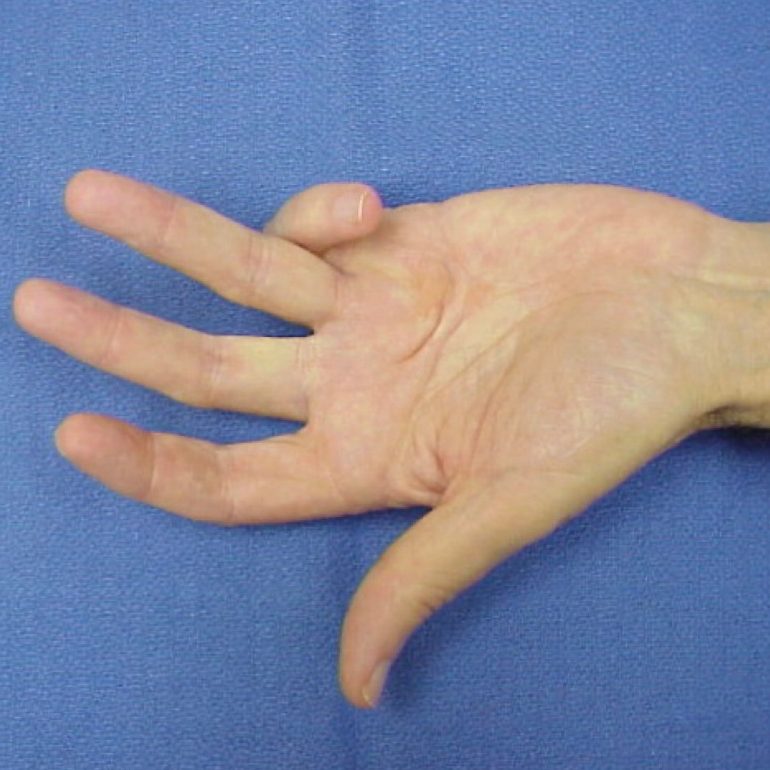
Dupuytren’s disease is a benign hand condition that gradually causes one or more fingers to bend towards the palm, making it difficult to straighten them. It develops when fibrous tissue under the skin of the palm progressively thickens and tightens over time, eventually results in finger contracture.
While it is not typically painful, it can significantly interfere with daily activities, such as shaking hands, putting on gloves, or grasping objects. Early diagnosis and treatment can help preserve hand function and improve quality of life.
What Causes Dupuytren’s Disease and Subsequent Contracture
The exact cause is not fully understood, but it is believed to involve a combination of:
- Genetics – Often runs in families (especially of Northern European descent)
- Abnormal collagen production – Leading to thickened, shortened cords in the palm
- Lifestyle factors – More common in people who smoke or drink heavily
- Medical conditions – Higher risk in those with type I diabetes or epilepsy
It is not caused by hand overuse or injury.
Signs and Symptoms
- Nodules – Small, firm lumps in the palm
- Cords – Thickened fascial tissue bands (known as “cords”) under the skin
- Finger bending – Usually affects the ring and little fingers first
- Reduced range of motion – Difficulty placing the hand flat on a surface
The condition usually progresses slowly over months or years.
When to See a Specialist Surgeon
Seek medical advice if you:
- Notice increasing difficulty straightening your fingers
- Find it difficult to place your hand completely flat on a table-top
- Have trouble with tasks like handshakes or pocket access
- See progressive curling of the fingers
Early assessment allows for more treatment options before severe contractures develop.
Treatment Options for Dupuytren’s Contracture
- Observation (Watchful Waiting)
- If mild and not affecting finger function, regular monitoring may be recommended.
- Non-Surgical Treatments
- Collagenase injection (enzyme therapy) – Breaks down the thickened cord to allow finger extension; potentially can cause skin tear / brusising.
- Needle aponeurotomy – Minimally invasive technique using a needle to divide the cords; but high risk of contracture recurrence and risk of damaging the finger nerves and vessels.
- Surgical Treatments
- Fasciotomy – Cutting the thickened tissue to release tension, though moderate chance of recurrence.
- Fasciectomy – Removing the affected tissue, whilst carefully dissecting around nerves and vessels to preserve function, for longer-lasting results.
- Fasciectomy with Joint Release & Reconstruction – for advanced stage of disease with significant joint contracture and lack of skin envelop due to prolonged flexion posture.
Recovery After Treatment
- Post-procedure splinting may be recommended to maintain finger extension.
- Hand therapy is always required early after treatment, to restore functional finger and hand movement.
- Recurrence is likely (as this is mostly a condition with high genetic predisposition) — ongoing monitoring is important.
Living With Dupuytren’s Contracture
- The condition varies greatly — some people have slow progression, others faster.
- Maintaining hand function with range of motion with stretching may help retain function.
- Early intervention can reduce the need for more invasive surgery.
About Dr Paul Cheng
I’m Dr Paul Cheng, FRACS, a Specialist Plastic, Aesthetic & Reconstructive Surgeon practising on the Gold Coast and in Ballina, NSW. I provide individualised treatment for soft tissue hand conditions, including Dupuytren’s Contracture, using both surgical and minimally invasive techniques.
If you have noticed changes in your hand function, please book a consultation for a thorough assessment.